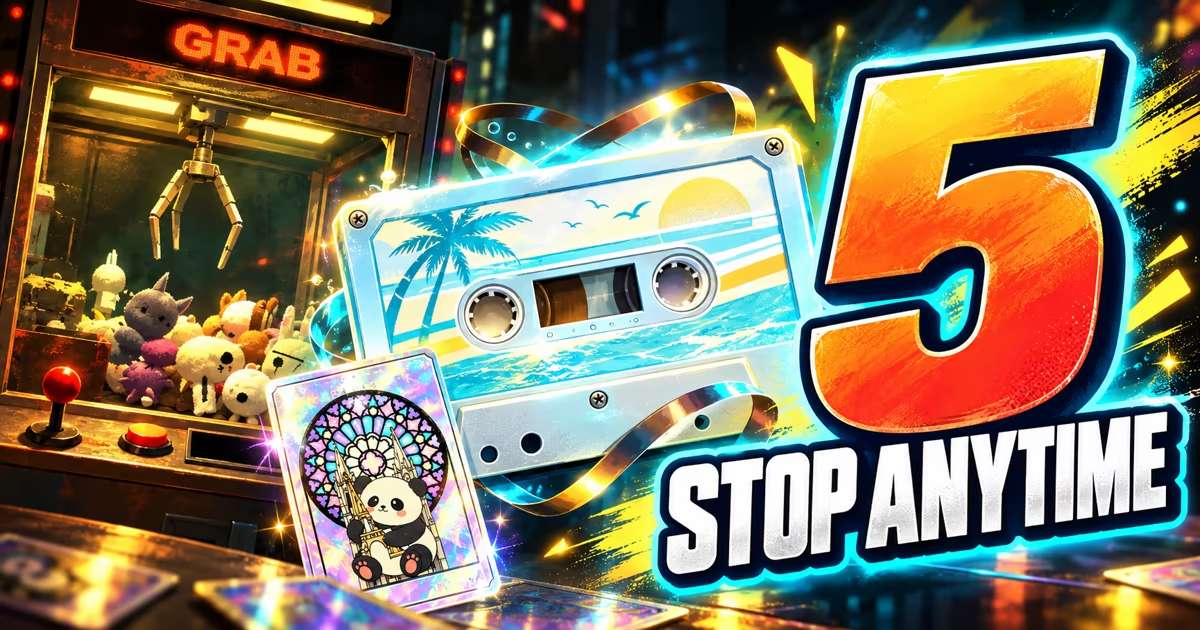
You have eight minutes, unless your name gets called in thirty seconds. Starting a quest would be irresponsible. Operating a haunted claw machine, however, fits the calendar.
These five short games are built for time that may disappear without notice. Grab one suspicious prize, draw a flower token, assemble a summer identity, inspect an apple through nine artistic lenses, or rotate a holographic panda until real life resumes. The point is not that every game is microscopic. The point is that leaving should not feel like abandoning a project.
GRAB — Night Shift
GRAB — Night Shift places a claw machine inside a dark, stripped-back arcade cabinet. The status begins at NO CREDIT. Insert a coin with C, move the claw with WASD or the visible direction pad, and press Space or DROP when the claw is in position. Mobile controls put the coin, movement, and drop buttons directly over the game rather than asking a touchscreen to impersonate a keyboard.
One attempt travels through a compact sequence: the claw accepts the credit, becomes ready, drops, closes, rises, returns to the chute, releases, and resets. A caught prize can slip during the return, and the machine includes a jumpscare, so this is the least calm option in the list. It is still a useful short-game shape. One coin creates one decision, one drop, and one natural place to leave.
Choose GRAB when you want an actual round rather than an object to inspect. The WebGL cabinet needs more loading and graphics power than the simpler pages below, and the horror presentation is a bad surprise if you wanted a silent waiting-room toy. Reality may refuse to estimate your remaining time, but the cursed claw machine at least has the decency to return to NO CREDIT.
Flower Fortune Telling
Flower Fortune Telling opens as The Flower-Token Banquet, a miniature inspired by A Dream of Red Mansions. Enter the night banquet, select Draw a flower token, then hold the vessel to draw from four blossoms. A collection counter begins at 0 / 4, giving the ritual an end without turning it into a long campaign.
The interaction asks for one deliberate action instead of rapid tapping. Garden ambience has its own control, and the bilingual presentation pairs English instructions with Chinese titles. The token is a literary entertainment result—a flower, temperament, verse, and meaning—not a prediction that has gained legal authority because it arrived before your friend did.
This is the best short pick when you want a result worth reading but no score to defend. It takes more steps than switching an apple style, and collecting all four blossoms may outlast a very short wait. Draw one token, read it, and leave the rest of the banquet for another night.
Summer Alter Ego Generator
Summer Alter Ego Generator begins with a six-tape Summer Music Archive. Swipe or use the arrows to move through the mixtapes, starting with Beach Tape — golden shore, then press Play This Summer. The tape is only the opening vote: the next screen asks you to choose among Strawberry Lemonade, Iced Matcha, Cold Brew, and Coconut Water before the summer identity continues taking shape.
That structure makes the App easy to sample in small pieces. Pick a tape, make a few aesthetic decisions, and let ordinary objects perform an amount of identity work that no beverage formally agreed to. There is no timer pushing the choices forward, and each screen presents a small set rather than a long form.
Choose this when you have a few minutes and want a themed result rather than a skill challenge. It asks for more attention than the apple or panda card, and its value depends on enjoying summer-aesthetic choices in the first place. The result is a playful alter ego, not a personality diagnosis delivered by iced matcha.
An Apple, Nine Visions
An Apple, Nine Visions gives one apple nine visual identities. Buttons switch among Picasso, Van Gogh, Monet, Mondrian, Dalí, Munch, Hokusai, Cézanne, and Rembrandt. There is no setup screen, score, or route to complete. Choose a name and the artwork changes.
The apple remains professionally composed while its entire visual career is reassigned nine times. That is the interaction: compare the treatments, stay on one you like, then move on. The page does not ask you to identify brushwork, pass an art-history quiz, or explain what the fruit symbolizes in your current era.
This is the easiest option to stop at literally any moment. It is also closer to an interactive visual study than a conventional game, and once you have viewed all nine versions there is little progression left to uncover. Pick it when a tiny gallery visit sounds better than beginning a round.
Ruarua Panda Holo Card
Ruarua Panda Holo Card is a Paris-themed collectible card built from four visible layers: a pearlescent background, a rose window, cathedral architecture, and ruarua with the Eiffel Tower. Drag the card to change its angle, flip it, reset the view, or start an automatic viewing rotation. Keyboard controls can rotate the card too.
The settings expose the effect instead of hiding it. Holographic shine and parallax depth have adjustable controls, while eye buttons let you hide each of the four source layers and inspect what remains. Remove the architecture and the panda is suddenly carrying much more of the Paris assignment than originally planned.
There is no round to lose because there is no round. That makes the card ideal when your free time could end on the next announcement, but it also makes this the thinnest experience in the list. Rotate it, find the angle where the light catches, and stop. When real life calls your name, close the tab. The panda will cope.
Choose GRAB for one contained game attempt, Flower Fortune Telling for a small result, Summer Alter Ego for a sequence of choices, An Apple, Nine Visions for instant visual switching, or the panda card when your remaining time cannot be trusted with a plot.
Need games designed around a more predictable pause? Try these quick games to play during a work break.