You sit down to make a five-question game for your friends. Half an hour later, you are planning avatars, levels, and a shop—but you still do not know how the first round ends. What if you started with five questions, or a button that refuses to be clicked, and let someone play the whole thing today?
The easiest first games have one main action, immediate feedback, and a visible finish line. A five-question quiz, a button game with one joke, or a short memory match gives you enough to make a complete round. The ideas below specify what the player wants, does, and sees at the end, so you can choose one without designing a whole game around it.
Compare 6 easy game ideas for beginners
| First-game idea | Player's goal and action | A complete first version ends when… |
|---|---|---|
| “Which teammate are you?” quiz | Choose an answer to five group-project mishaps to discover a result. | Question five reveals a result card and a replay option. |
| Button that runs away | Try two buttons and discover that one dodges your pointer. | The player reaches the reveal screen. |
| Missing-sock memory match | Turn over two cards at a time to reunite six pairs of socks. | All six pairs are found and the game shows the move count. |
| Catch the cookies | Tap a cookie each time it appears to build a score. | The 30-second timer reaches zero and the final score appears. |
| The locked greenhouse | Choose one of two actions at each story turning point. | The last choice leads to one of two short endings. |
| Robot battery hunt | Move across one screen and collect five lost batteries. | The fifth battery triggers a win screen and restart. |
“Which teammate are you?” quiz
- Player's goal and action
- Choose an answer to five group-project mishaps to discover a result.
- A complete first version ends when…
- Question five reveals a result card and a replay option.
Button that runs away
- Player's goal and action
- Try two buttons and discover that one dodges your pointer.
- A complete first version ends when…
- The player reaches the reveal screen.
Missing-sock memory match
- Player's goal and action
- Turn over two cards at a time to reunite six pairs of socks.
- A complete first version ends when…
- All six pairs are found and the game shows the move count.
Catch the cookies
- Player's goal and action
- Tap a cookie each time it appears to build a score.
- A complete first version ends when…
- The 30-second timer reaches zero and the final score appears.
The locked greenhouse
- Player's goal and action
- Choose one of two actions at each story turning point.
- A complete first version ends when…
- The last choice leads to one of two short endings.
Robot battery hunt
- Player's goal and action
- Move across one screen and collect five lost batteries.
- A complete first version ends when…
- The fifth battery triggers a win screen and restart.
The core game loop is the action and response a player repeats. For a first project, make that loop understandable before adding levels, accounts, a store, or multiple modes.
Personality quiz game: Which Teammate Are You?
Goal: Discover a playful result. Action: Choose one answer per question. Ending: Show a named result with a sentence explaining it and an option to try again.
Give the player five miniature group-project crises: the deadline moves up, the presentation file disappears, or nobody agrees on a title. Each answer nudges them toward one of three results, such as The Organizer, The Improviser, or The Last-Minute Hero. That is more fun to share than a result picked at random. Show one question at a time; add more only after people understand why they got their outcome.
What Kind of Intern Are You? is a playable Eazo example. Its five workplace scenarios lead to an intern archetype and a printable badge. This makes the scope easy to see: five decisions, then a result.
One-rule button game: The Runaway Button
Goal: Find out what happens when you press a button. Action: Try the two visible choices. Ending: One choice leads to a playful result screen.
This idea suits a joke, invitation, or tiny surprise. Put two choices on one screen, then make one button dodge the pointer. The player immediately understands the joke because the page reacts to their attempt. Keep the first version to one screen and one reveal; extra dialogue and scoring would delay the punchline.
In Eazo's Do you love me?, the opening screen presents Yes and No. Pressing Yes leads to a heart-filled “I KNEW IT!” result; the No button moves away when a player tries to select it. The point for a beginner is the size of the interaction: one setup, one surprising behavior, one payoff.
Memory match game: Where Did the Socks Go?
Goal: Find six matching pairs. Action: Turn over two cards and remember their positions. Ending: Reveal all pairs, show how many moves it took, and offer a restart.
Give each sock pair a distinct pattern: stripes, stars, cherries, little ghosts. The joke is that the dryer has mixed them all up. Start with 12 cards in a fixed grid, so the challenge comes from remembering positions. A timer and difficulty selector can wait until flipping, matching, and finishing work.
30-second reaction game: Catch the Cookies
Goal: Tap as many appearing targets as possible in 30 seconds. Action: Tap the target when it appears in a new position. Ending: Show the count when the timer expires.
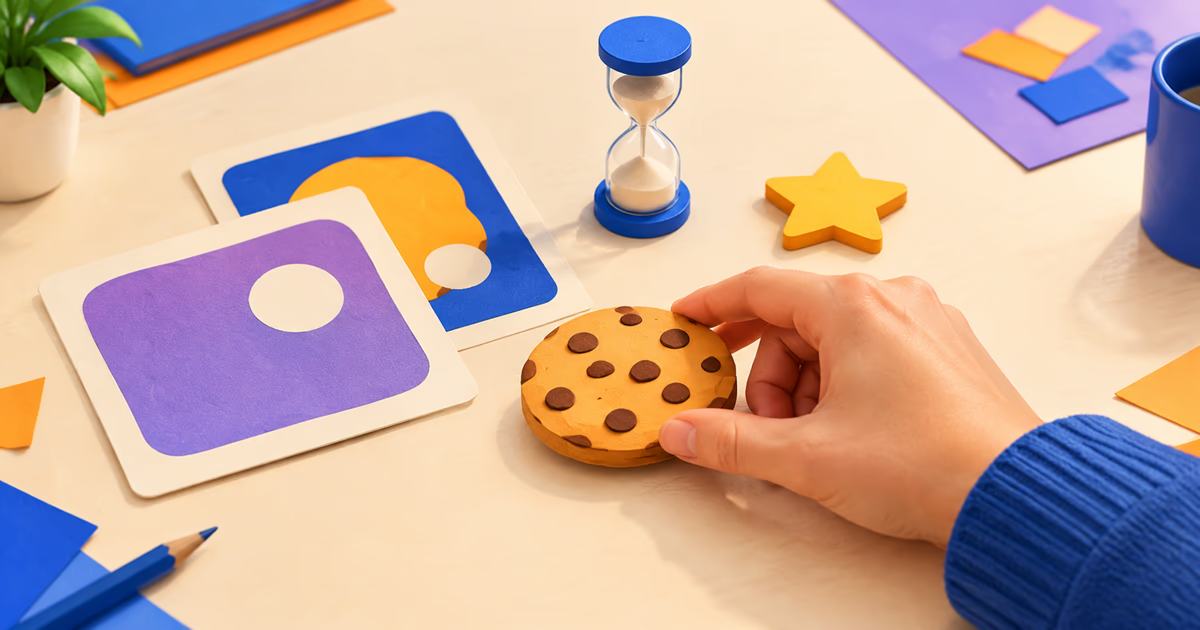
Imagine cookies appearing in different spots on a kitchen counter. Every tap makes one disappear, adds a point, and places the next one. This is a good choice if you would rather tune timing than write questions. The first version needs a target large enough to hit, a visible countdown, and a final score. A tap outside the cookie can simply do nothing.
Choice-based story game: The Locked Greenhouse
Goal: Reach an ending by making two decisions. Action: Choose between two options at each scene. Ending: Show one of two outcomes that reflects the player's choices.
The player finds a locked greenhouse and chooses whether to ask the gardener for a key or search for another entrance. The next scene responds to that choice; the last decision determines whether they discover a midnight flower or the gardener's secret. Write the two endings first so every choice has somewhere to lead. You can expand the world after the short path works on its own.
Collecting game: Help a Robot Find Its Batteries
Goal: Pick up five objects on a single screen. Action: Move one character toward each object. Ending: The fifth pickup triggers a win message and replay button.
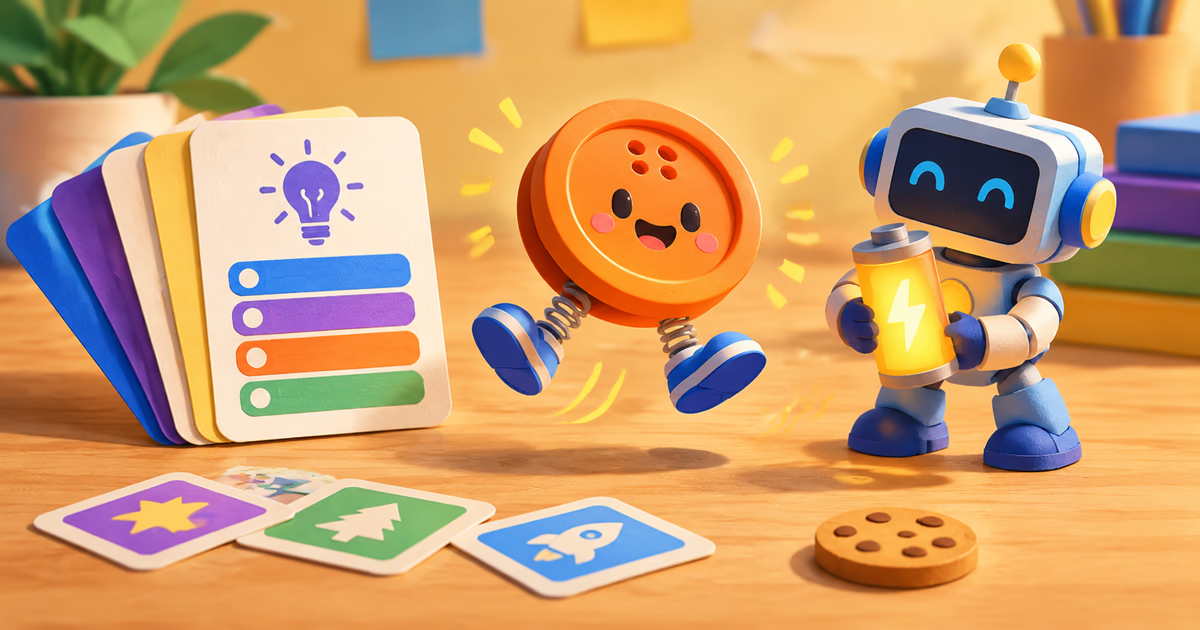
A tiny robot wakes up with almost no power. Five batteries are scattered around one room, and each pickup brightens the robot a little. Place the batteries where players can see them and make each pickup visibly count. Keep the first version to that room; if moving and collecting feels satisfying, you have a game loop to build on.
How to choose your first game idea
Choose by the work you want to do, not just the theme you like. A quiz is easy to navigate but needs questions and results worth sharing. A choice story needs endings that respond to the player's decisions. A reaction game needs clear timing and feedback; a collection game needs movement that feels good. A memory match has familiar rules but still needs reliable flip and match states. A runaway button is a quick joke on a computer, but think through how the joke will work on a touch screen, where there is no pointer hovering over it. For a wider view of casual games, quizzes, and stories, browse Eazo's Games & Entertainment ideas and playable examples.
Use a simple test before you begin: can you explain the player's goal, main action, and ending in three sentences? If the ending is still “then the game continues,” make the first round smaller. Finishing one round gives you something real to show a friend—and a better basis for deciding what to add next.
Your next step depends on what is uncertain. If you want to know whether the action works, prototype the game idea and watch where a new player hesitates. If you are ready to build and share a complete round, follow the beginner's guide to making a game without coding.
If you want to make a version without writing code, Eazo Creator lets you describe the game in a prompt, review design directions, build a playable App, and revise it through conversation. Try the two public games above for inspiration, then use the goal, action, and ending of your favorite idea as a starting brief.
For example, you could start with: “Make a five-question quiz called Which Teammate Are You? Show one group-project dilemma at a time, with three answer choices. Finish with one of three result cards that explains the player's choices and a Play Again button.” Prefer movement? Ask for the robot battery hunt instead, specifying one room, five visible batteries, a pickup counter, and a win screen. Try the full round yourself, then ask Eazo to fix anything confusing.