The best party question is often the one nobody outside the room could answer. “Who got locked out of the holiday rental?” can start a story before anyone cares who won. You can turn those shared moments into a game without buying a box or making every guest perform in front of the room.
For a mixed group, start with a low-pressure arrival game; for close friends, use photos or shared memories; for a seated group, run a short quiz or caption round. The six games below include rules you can use tonight. The times are planning estimates for one round, not promises about how long your group will take.
Compare 6 DIY party game ideas
| Game | Best for | Place | Prep | Round |
|---|---|---|---|---|
| Find the guest bingo | 8–30 people, including new acquaintances | Room to mingle | 10 min | 10–15 min |
| Caption this photo | 4–16 friends | Table or sofa | 10 min | 15 min |
| Who knows the host? | 4–20 people who know the host | Seated, or remote | 15 min | 10–20 min |
| Secret missions | 6–25 people | A party with time to mingle | 5 min | 30–60 min in the background |
| The shared-memory timeline | 4–12 close friends | Seated | 15 min | 15 min |
| Common-ground challenge | 6–24 guests who just met | Small standing or seated groups | 2 min | 5–10 min |
Find the guest bingo
- Best for
- 8–30 people, including new acquaintances
- Place
- Room to mingle
- Prep
- 10 min
- Round
- 10–15 min
Caption this photo
- Best for
- 4–16 friends
- Place
- Table or sofa
- Prep
- 10 min
- Round
- 15 min
Who knows the host?
- Best for
- 4–20 people who know the host
- Place
- Seated, or remote
- Prep
- 15 min
- Round
- 10–20 min
Secret missions
- Best for
- 6–25 people
- Place
- A party with time to mingle
- Prep
- 5 min
- Round
- 30–60 min in the background
The shared-memory timeline
- Best for
- 4–12 close friends
- Place
- Seated
- Prep
- 15 min
- Round
- 15 min
Common-ground challenge
- Best for
- 6–24 guests who just met
- Place
- Small standing or seated groups
- Prep
- 2 min
- Round
- 5–10 min
These are suggested group sizes and times; adjust them to your room and the people in it. If guests are meeting for the first time, choose a game that gives them something to say to one another before asking them to recall shared history.
Find-the-guest bingo for new groups
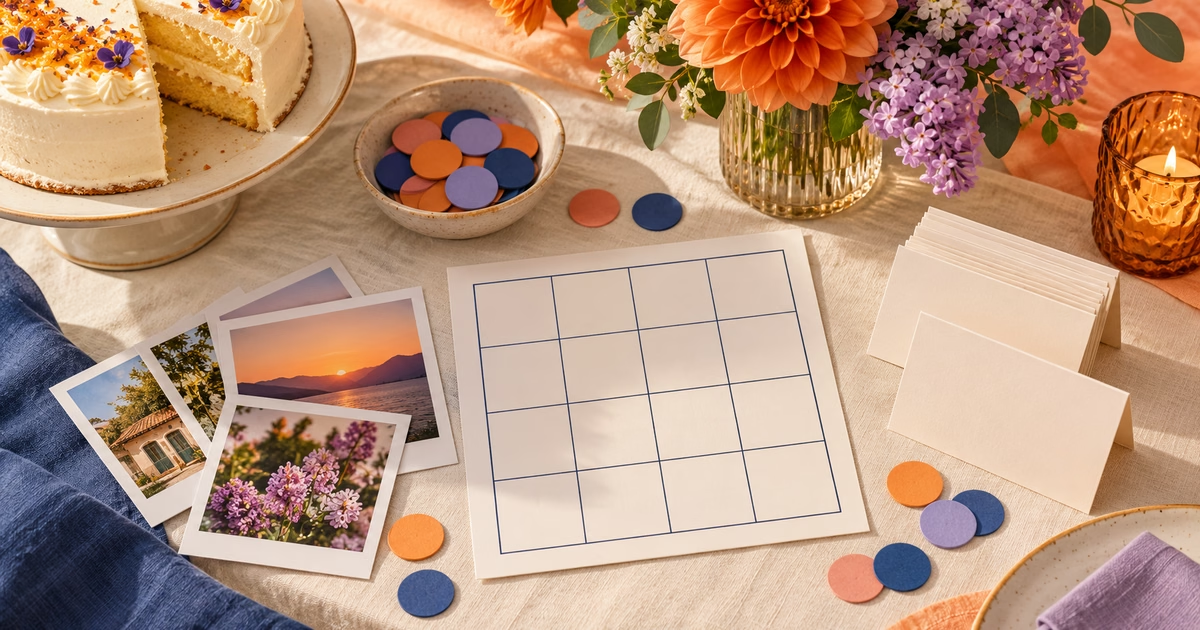
Prepare: Draw a 4×4 grid for each guest. Fill squares with approachable prompts such as “has visited the host's hometown,” “can recommend a late-night snack,” or “has a photo with a pet.” Avoid facts someone might not want to disclose.
Play: Guests ask one another questions and write a person's name in a matching square. A name can appear only once per card. The first person to complete a line calls bingo; have them introduce two of the people they met before giving a prize.
Make it personal: Use places, hobbies, or harmless stories connected to your group. If half the guests are new, give them prompts they can answer without knowing anyone's history. A printable find-the-guest example shows how this format works on paper.
Photo caption game for close friends
Prepare: Pick three photos the subjects are comfortable showing. A blurry holiday dinner, a group selfie taken just before the rain, or the host carrying too many grocery bags can work. Put each photo on a screen or print it.
Play: For each photo, give everyone one minute to write a caption. Read them without names. The person in the photo chooses the funniest caption, or the group votes. One point per round is enough; stop after three photos.
Make it personal: Ask for captions in the voice of someone in the group, a fake newspaper headline, or the message that would have appeared in the group chat. Check with the people pictured before using a photo, especially if the joke depends on an awkward moment.
Who Knows the Host? trivia game
Prepare: Ask the host or guest of honor for answers to six questions in advance. Mix easy facts with story prompts: “Which meal would they happily eat three days in a row?” and “What was the first thing they said after the train was canceled?” Keep an answer key. Avoid private or embarrassing details.
Play: Guests answer alone or in teams of two. Read one question at a time, let everyone commit an answer, then reveal the host's answer and the story behind it. Award one point for a match. A tie can end with a final “closest guess” question.
Make it personal: Replace generic birthday facts with a shared trip, recurring joke, or a favorite place. If guests do not all know the host well, use teams so newcomers can join the conversation. Keep this version to six questions so the stories behind the answers have room to breathe.
If this is the main event rather than one short round, the party trivia guide walks through question types, scoring, and the final reveal.
A digital version can show each question and reveal on a phone or shared screen. Try Eazo's What Kind of Intern Are You? to see how a five-question game moves from choices to a result. For your party, replace the workplace scenarios with shared memories and the result with a score.
To make your own version, start with a prompt like this:
Make a six-question “Who Knows the Host?” game for a birthday dinner. Show one question at a time and let players choose from three answers. Use the six questions and correct answers I provide; do not invent facts about our friends. Reveal the correct answer and one short story after each question, then show a final score and Play Again button. Make the text easy to read on a phone.
Add your real questions and answer key before you build, then play the full round yourself. If you use one shared screen at the party, have guests record their answers on paper before each reveal.
If a quiz is not quite right for your group, browse Eazo's casual game and interactive story ideas for another format you can make personal.
If the digital part is new to you, the beginner's guide to making a game without coding explains how to move from a prompt to a playable link.
Secret missions for mingling
Prepare: Write one harmless mission per guest on a folded slip: “Get someone to recommend a song,” “Find two people who prefer the same dessert,” or “Persuade someone to describe the host in three words.” Avoid tasks that pressure people into photos, drinks, or personal disclosures.
Play: Give each guest a mission as they arrive. After 30–60 minutes, reveal the missions and let people guess who completed theirs. You can award a point for completion, but the reveal is usually enough of a payoff.
Make it personal: Refer to the evening's theme, the host's famous snack, or a running group joke. Keep every mission possible for a newcomer to complete.
Shared-memory timeline game
Prepare: Write five events from the group's history on separate cards. Include a mix of obvious and debatable dates: the first group trip, a memorable dinner, the day someone adopted a dog. Ask one person to verify the real order before the party.
Play: Divide guests into two teams. Give both teams the same five events and two minutes to arrange them from earliest to latest. Reveal the correct order and ask one person to tell the story behind the event the room argued about most. Score one point per correctly placed card.
Make it personal: Use events everyone involved is comfortable revisiting. If several guests joined recently, choose a shared period they know or pair this with a newcomer-friendly game.
Common-ground challenge for new guests
Prepare: No materials are required. Split guests into groups of three or four and set a three-minute timer.
Play: Each group must find three specific things everyone shares. “We all like food” does not count; “we would all choose the window seat on a train” does. Each group shares its most surprising match. Let the room vote for the most specific discovery.
Make it personal: Give the groups a theme tied to the gathering, such as travel, music, or places in the city. This works well before a game based on the host's memories because it gives guests new stories of their own.
Choose a party game and a backup
For a two-hour gathering, one arrival activity and one seated round are usually enough. Use bingo or common ground when guests need introductions; use captions or a timeline when they share history; use the host quiz when one person or occasion is the focus. Keep a paper version of the questions if your digital game or Wi-Fi has trouble. The aim is to give people a reason to talk, then let the conversation take over.