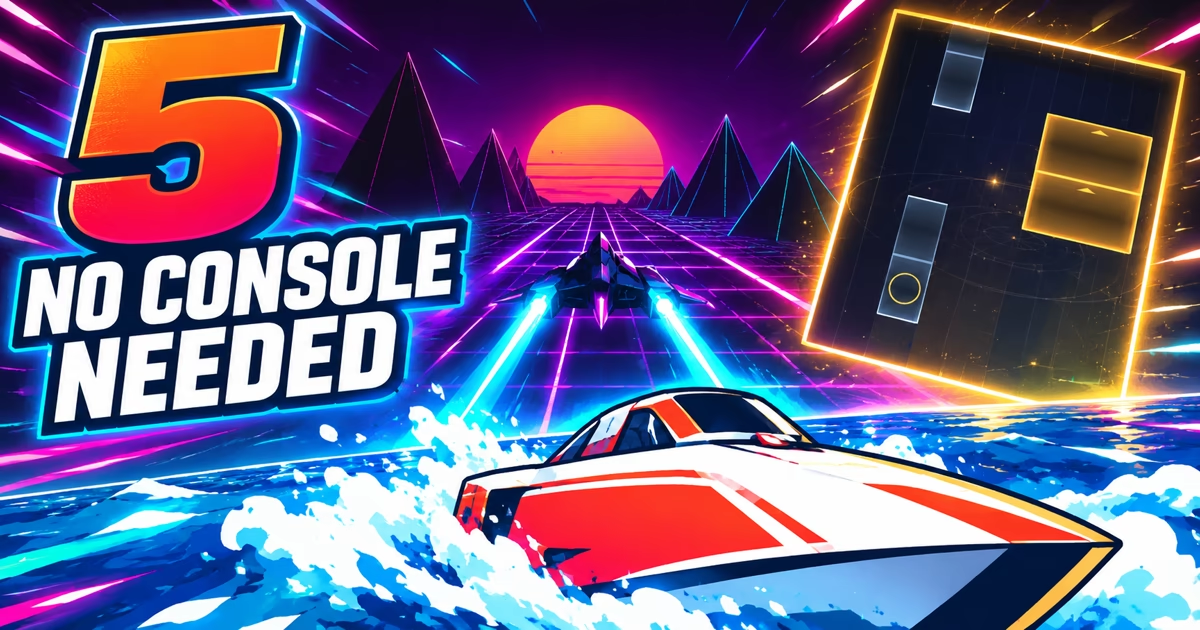
You do not own a console. The browser has responded by handing you a spaceship, a speedboat, nine camp badges, and permission to launch a rocket. Background checks have become extremely casual.
These online games cover five very different assignments without asking for new hardware. Auto-fire through a neon frontier, race three opponents over three laps, collect shells at a campground, control rocket thrust with your hand, or play musical scales from eleven places around the world. The controller under the television may be imaginary. The responsibilities are unfortunately real.
Neon Drift
Neon Drift puts a small synthwave ship on an endless neon frontier and handles the shooting for you. Move with WASD, the arrow keys, or the mouse while auto-fire shatters crystals and hunts drones. Stars and energy wait along the route, chain kills raise the multiplier, and one hit resets it while the speed continues climbing. Very supportive environment.
A short run put 200 on both the current and best score while the speed display reached 390 km/h. The shield bar was still holding, the sunset was enormous, and several glowing objects were approaching with opinions. The game includes Pause, Mute, and a leaderboard, but the main skill is reading the lane quickly enough to avoid converting the ship into a brief lighting effect.
This is the strongest immediate-action choice because there is almost no setup between Start Run and movement. Its endless structure also means the reward is a better score rather than a finished campaign. Choose it when “no console” still needs to feel fast, loud, and slightly irresponsible.
Anime Ocean Racer
Anime Ocean Racer trades the neon tunnel for a cel-shaded regatta. You line up against Mako, Sora, and Ren in third position, then use W/S or the up and down arrows for throttle and braking. A/D or the left and right arrows steer; hold brake while turning to slide.
The race is structured around three laps, a next-gate marker, a track map, and ten blocks of slide boost. Before the start, our boat sat at 000 km/h, eight metres from the first gate, surrounded by rivals and a giant GO! panel. It had the posture of a champion and the velocity of patio furniture.
Pick this when you want a defined course and opponents rather than Neon Drift's endless survival. Steering, throttle, braking, and sliding make it the more demanding control scheme, while the bright map keeps the route visible. A keyboard is the natural home for it; this is not the game to open when one finger and half your attention are available.
Pointer Campground
Pointer Campground makes the cursor the explorer. Walk it around the illustrated camp, collect seashells, spend them on gear in the Shop, and check the Badges panel as the campground decides whether your wandering deserves formal recognition.
The opening report begins at 0 shells and 0/9 badges, then gives one excellent instruction: “Walk your cursor around the camp.” Progress is stored on the current device, so a quiet visit can become a longer collection instead of resetting every time. Apparently moving a pointer through the woods is now an outdoor qualification. We accept the badge authority.
This is the slowest, friendliest option in the group and the best choice when a racing line sounds exhausting. The tradeoff is that the pleasure comes from finding and collecting rather than dramatic failure. Use it when you want a small world to inspect, not a machine that displays your speed in three enormous digits.
Launch Your Rocket
Launch Your Rocket opens with Falcon One in free fall and the invitation Take Control. Enable the camera, hold a fist in frame, and the detected fist rate becomes thrust through a cinematic launch, flight, and sea-recovery sequence.
The mission display tracks altitude, velocity, thrust, and stage status. Our anonymous test reached the vision-loading stage at about 60.5 km altitude with thrust at zero, while the interface repeated Keep fisting — hold the rocket up. Aerospace has spent decades developing precise terminology. The browser has chosen this.
This is the most technically ambitious game here and the only one that makes a camera part of the controller. That also makes it the pick with the most setup: lighting, permission, framing, and gesture recognition all matter. Open it when you want the browser to attempt something genuinely strange and have enough room to wave at the launch program.
Between the Keys
Between the Keys turns tuning systems into a playable falling-key exercise. Press Play, tap the lit key, and move through scales associated with eleven places and traditions, including Java, China, Japan, Thailand, Scotland, Egypt, Turkey, the Arab world, Surakarta, just intonation, and twelve-tone equal temperament.
The China screen presents five steps derived from string lengths in the Shiji: 81, 72, 64, 54, and 48. It plots the resulting notes at 0, 215, 443, 714, and 931 cents, then lets the falling blocks turn that explanation into something audible. One tab has become a music game, a scale atlas, and a small argument with the assumption that every octave must be divided the same way.
This is the best choice for curiosity rather than competition. Sound is the point, and the amount of explanatory text makes it more rewarding on a decent-size screen. The game asks for attention, not reflex heroics; take the time to listen before racing toward the next key.
Choose Neon Drift for immediate speed, Anime Ocean Racer for a proper course, Pointer Campground for collecting, Launch Your Rocket for camera-powered chaos, or Between the Keys when the speakers are available and the octave deserves a field trip.
No console appeared during this process. The browser has nevertheless assigned the entire evening. If you want something even faster to enter, use these free online games you can play right now.