Your laptop opened three tabs and started breathing like it knows something you don't. Asking it to render a cinematic universe would be rude.
Give it a manageable assignment instead. These browser games stick to numbers, drags, swipes, written choices, and one emotionally significant block of tofu. You can merge a 2048 board, negotiate personal space with a ring, cook three moods in an appliance that should not be licensed, slice bad luck into 16 pieces, or receive a very loud intern badge. The fan may still have notes. It loves the meeting.
2048
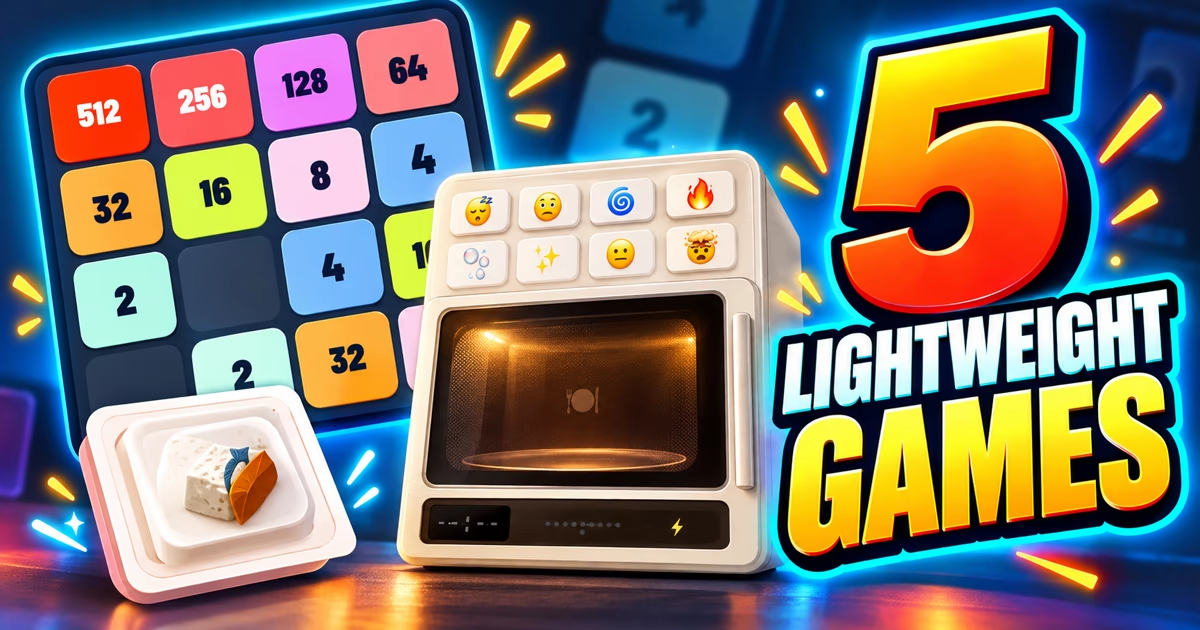
2048 keeps the classic assignment intact: use the arrow keys or swipe to move every tile, merge matching numbers, and keep making space until the board stops cooperating. This version puts Score, Best, and Restart above the four-by-four grid, while a color strip below shows the climb from 2 toward 2048.
The useful thing about a familiar game is that the first move does not require a committee. Our test board responded immediately to arrow-key sequences, moving the empty spaces and compressing the numbered rows. The dangerous thing about a familiar game is that one bad swipe still looks recoverable for several turns. It is not. The board is simply allowing hope to finish its presentation.
This is the safest first pick for a modest computer because it does not need elaborate art or a high frame rate to explain itself. The tradeoff is equally obvious: it is 2048, not a mysterious new genre arriving at your door. Choose it when reliability beats novelty and a blocked corner is the amount of drama your machine can support today.
Close Enough
Close Enough is a game about maintaining the correct amount of distance, a task humanity has traditionally handled with flawless consistency. Drag anywhere to keep a moving ring between too close and too far, then choose who you are playing with.
The opening offers two dynamics. “The one who pulls away” comes close and then needs air; reach faster and they move farther. “The one who needs more” keeps closing the gap and takes the room when given an inch. The notes counter begins at 0/13, while locked milestones ask you to play two rounds, reach something real, and try three different people. A minimalist circle has already developed attachment lore. No one authorized this level of emotional infrastructure.
Close Enough looks simple, but its judgment depends on movement staying readable, so it is a better fit for a computer that handles basic animation smoothly. It also has more interpretation than 2048: the ring is easy to drag, while the relationship it represents remains professionally unresolved.
Mood Microwave
Mood Microwave presents eight feelings as ingredients: Tired, Anxious, Chaotic, Angry, Sad, Euphoric, Bored, and Confused. Pick up to three, load them into a 1000W EMO-WAVE, then hold the button to cook whatever psychological snack this deeply unregulated appliance believes you need.
We loaded Tired + Chaotic + Euphoric, which sounds less like a mood and more like the final hour of a wedding. A short cook produced the warning Undercooked feelings — still a little raw and asked us to hold again. The machine was correct. The feelings had not reached a safe internal temperature.
This is the funniest low-effort option in the list because the entire interface is buttons, a timer, and appliance-grade confidence. The payoff depends on trying different combinations rather than mastering a difficult control. It is also intentionally slight: once the emotional menu stops surprising you, there is no larger campaign hiding behind the microwave door.
Fuzzy Tofu
Fuzzy Tofu turns clearing bad luck into a small preparation ritual. Press Clear the Bad Luck and the first instruction is unexpectedly technical: make three horizontal cuts and three vertical cuts to divide the tofu into 16 pieces. Swipe along the guide lines and the tray records each cut.
Only after the geometry is complete can the pieces be swiped away. The experience describes 15 kinds of bad luck waiting in the tofu, which means misfortune has been portioned for operational efficiency. This is reassuring. Nobody likes an unstructured curse.
The large tray and guided lines make the task easy to read without complex rendering or fast reactions. Dragging long cuts feels more natural with a trackpad or touch surface than a stiff mouse, and the ritual is finite rather than endlessly replayable. Pick it when you want a task with a finish line and would like that finish line to remove several categories of nonsense from your week.
What Kind of Intern Are You?
What Kind of Intern Are You? announces its methodology immediately: Five tiny choices. One very loud badge. The five workplace scenarios cover Slack habits, LinkedIn tempo, and calendar behavior, then print an intern archetype at the end.
That is an excellent computational bargain. Five buttons go in; an entire professional identity comes out. No graphics card needs to model your calendar etiquette in real time. It already knows what you did.
This is the easiest option for someone who wants to read and choose rather than steer, time, or drag. It also has the lowest reason to replay once you have seen your badge, unless you return to conduct the respected scientific practice of changing answers until the result agrees with you.
Use 2048 when the keyboard is ready and your brain already knows the rules. Choose Close Enough for a little motion, Mood Microwave for a little emotional catering, Fuzzy Tofu for a guided ritual, or the Intern quiz when five clicks are the full available budget.
Your computer has completed the assignment. Please acknowledge its contribution before opening these browser games for school or work computers.