
A blank canvas is technically full of possibility. It is also a white rectangle staring at you like, “Well?” We do not need that kind of pressure today.
These five free online art games give you an excuse to begin before your inner art critic has finished putting on its little scarf. Draw from a witness statement. Misremember a cartoon character. Make gravity do the painting. Rearrange somebody else’s paper shapes. Draw a potato and inform the aquarium that it is a fish now. Talent is welcome, but it is absolutely not supervising this activity.
Forensic Artist Challenge
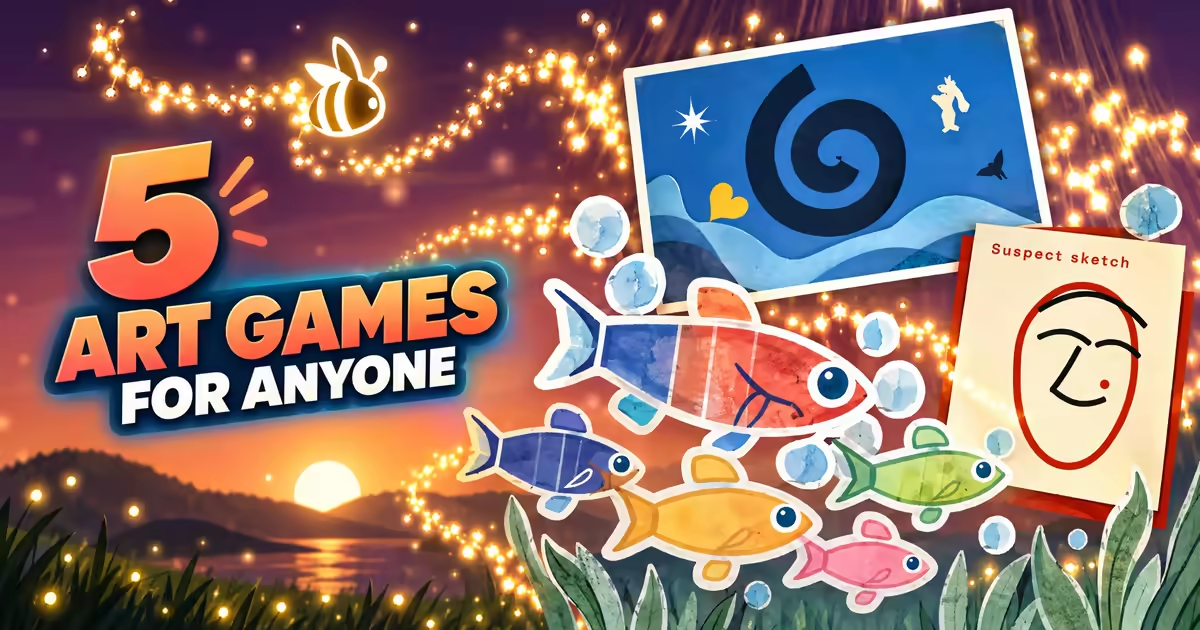
Forensic Artist Challenge opens a police file and gives you a witness description one clue at a time. Our first suspect had allegedly stolen sausages from a convenience store, so the justice system was clearly under enormous pressure. The witness remembered a long face, a pointed chin, and a red cap. We drew something that looked less like a criminal and more like a garden gnome who had received bad news.
Once the portrait is finished, the game shows four suspects and asks you to identify the actual culprit. That second step saves the whole idea. Your sketch is not graded by some ruthless face-recognition machine; it is simply a record of what happened inside your head while reading the clues. You can draw a person who has never existed in this or any other legal jurisdiction and still crack the case.
There are five cases, and the increasingly specific witness statements keep the joke alive longer than expected. The bilingual interface is easy to switch, and the canvas feels best under a finger or stylus; a mouse works, but gives every face the emotional texture of a tax form. The drawing itself has no effect on the final answer, so this is partly a deduction game wearing an artist badge. Given the quality of our evidence, that is probably good news for civil liberties.
Cartoon Sketch Challenge
Cartoon Sketch Challenge gives you five clues about a famous character, revealing them slowly enough for you to commit to several bad decisions. First: round cheeks. Fine. Then triangular ears. Still recoverable. Red circles on the cheeks. Yellow body. Lightning-bolt tail. The answer is Pikachu; the drawing on our screen was an anxious lemon who had recently discovered electricity.
You get a pen, eraser, color palette, several line widths, and the ability to clear the evidence and begin again. After the fifth clue, submit the sketch and choose the intended character from four options. The game then moves to the next of five familiar cartoon figures. It is part drawing challenge, part pop-culture quiz, and part live documentation of how long you continued pretending the ears were supposed to look like that.
The best moments happen in the middle, when three clues point vaguely toward several characters and you have to choose a direction. The final clues often make the answer obvious, so recognizing the character is rarely difficult. Five fixed levels also means the mystery disappears after one run. Still, it is generous about bad art: nothing scores your proportions, nobody confiscates the yellow pencil, and the game never asks whether Pikachu is receiving appropriate care.
Bee Swarm Brush
Bee Swarm Brush understands that controlling the brush is the part causing trouble, so it takes the brush away. Tap to place a golden gravity well that attracts a glowing swarm. Press and hold to create a blue one that pushes it away. The particles bend around your little force fields and leave trails behind. You are not painting so much as establishing unusual working conditions for several hundred luminous bees.
A round lasts 45 seconds, which is just enough time to form a plan, ruin it, and decide the ruin has movement. Alternate attraction and repulsion and the swarm produces loops, knots, spirals, and long comet tails. When time expires, the game frames the result as a finished artwork, counts your wells, and writes a poetic caption. Our three-well accident was named “bee-paths burned into dusk.” The machine believed in the work immediately. We are trying to reach that level of confidence.
You can influence the image without fully controlling it, which is precisely why the results look more complicated than anything you could draw line by line. Do not arrive hoping to make a recognizable horse. Physics has other meetings. The portrait layout and tap-versus-hold controls are also much nicer on a phone or tablet than with a mouse. As a serious drawing program, it would be chaos. As a 45-second machine for producing suspiciously presentable light art, it works.
Cut-Out Studio
Cut-Out Studio begins by quietly doing the hardest part of design: having taste before anything exists. Choose a palette—Jazz, Ocean, Garden, Blue Nude, or Icarus—then pick an arrangement, paper shape, background, and number of pieces. Press Generate and a titled collage appears, looking annoyingly intentional despite having been alive for less than a second.
Now you get to interfere. Drag a shape, rotate it, resize it, flip it, duplicate it, recolor it, or move it forward and backward through the stack. You can throw the whole layout into the air with Repin, add more pieces when restraint becomes boring, ask for a new title, and export the result as a poster. Switching our Ocean collage to Garden produced an 18-piece composition called “Green Vine III.” It already looked finished, so naturally we moved everything six pixels and took credit.
This is the most capable App in the group because its limits give you something concrete to react to. The paper texture, palette, and generated shapes provide momentum; you only have to notice what should move. That is also how a surprising amount of real design work happens, except here nobody asks for the logo to be larger. The interface is dense, with a long control panel, precision handles, and shortcuts, so use a desktop if possible. On a phone, making a poster involves enough scrolling to qualify as cardio.
INK TANK
INK TANK asks you to draw one closed loop. It does not request fins, scales, eyes, bones, or proof that you have seen a fish before. Close the shape and the game turns your outline into a living creature, then releases it into a watercolor aquarium containing 11 hand-drawn residents. Circles become fish. Long beans become fish. A shape best described as “medical concern” also becomes fish. The tank does not discriminate.
The moment of transformation is ridiculously satisfying. A line that meant nothing half a second ago suddenly has a body, a direction, and a swimming style. Different silhouettes move differently, so each new creature preserves something about the hand that made it without ever asking whether that hand understands marine biology. It may be the kindest possible response to a bad drawing: give it a tiny life and let it leave the conversation.
There is one piece of bureaucracy: the loop really must close. Leave even a small gap and the game returns your application with Close the loop, which happened to us immediately. The detector can be fussier than the human eye, especially with a mouse. It also favors a tall screen, and shorter displays may require a scroll to reach the drawing area. Those are small annoyances. Once your lopsided potato swims past the professional fish as if it has always belonged there, the aquarium wins the argument.
You now have a suspect sketch that may obstruct justice, fan art that should not be shown to Pikachu, a painting mostly completed by bees, a poster you barely had time to ruin, and a fish whose internal organs remain a private matter.
You have made art. Please do not ask whether the fish is okay.
Need a creative break that ends a little faster? Try these free online games to play at work.